
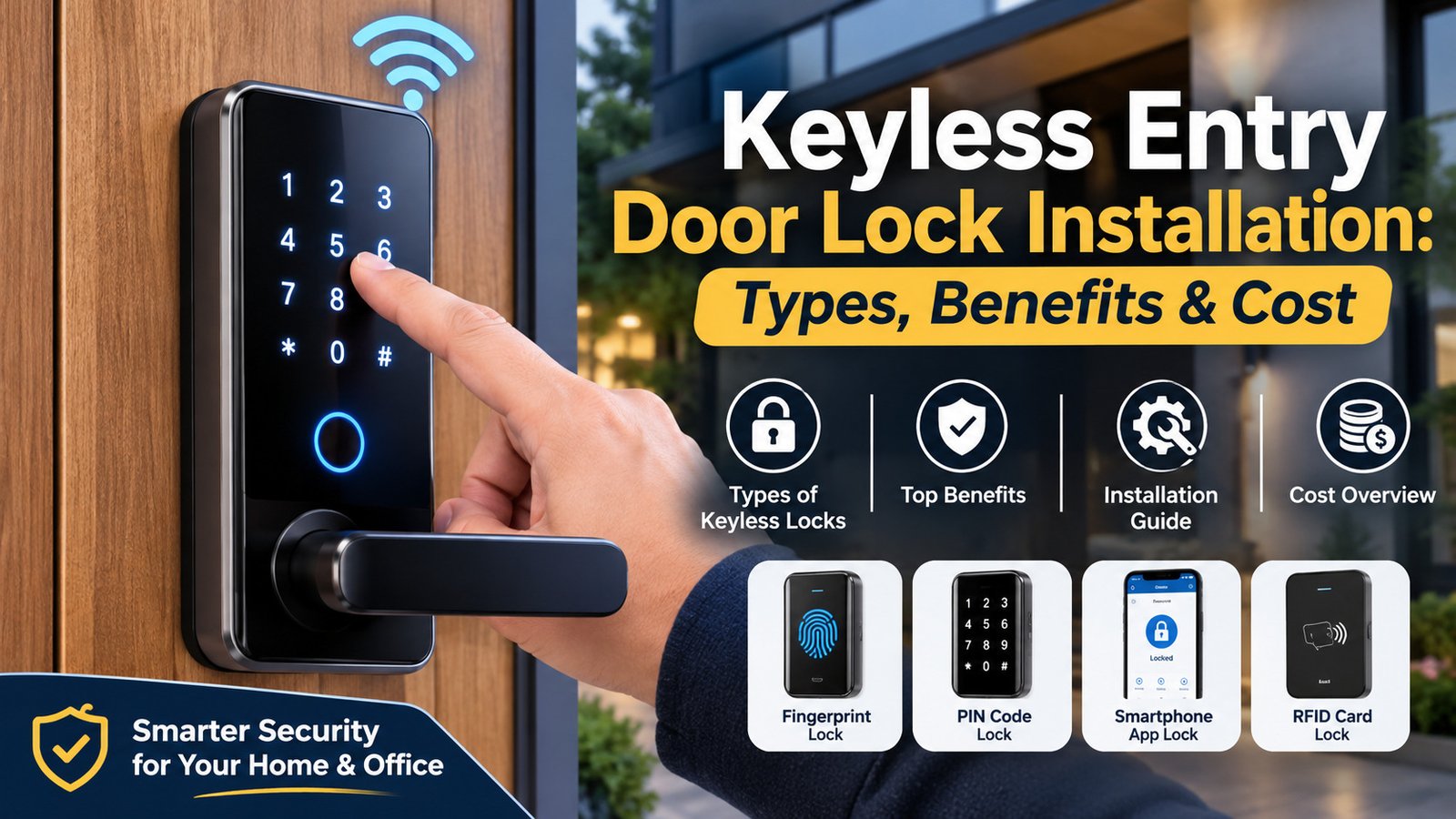
Keyless Entry Door Lock Installation: Benefits, Process & Costs
Even something as basic as entering your house can become needlessly problematic due to a misplaced key, a forgotten spare, or the inconvenience of giving keys to family members and guests. By enabling authorized users to open doors using a PIN code, fingerprint recognition, access card, or smartphone rather than a conventional key, keyless entry door locks greatly minimize this obstacle.
But convenience is only part of the benefit!
Installing keyless entry door locks can also provide property owners greater power over who visits their residences or places of business, strengthen access control, and make security administration easier. These systems are helpful for contemporary residential and commercial properties because of features like automatic locking, limited access codes, remote operation, and entry notifications.
A keyless entry system provides a more flexible solution to govern entry, whether you want to add to workplace safety, manage access to a rental home, or retrofit the front door of your house.
What, therefore, makes these locks worthwhile? How do they operate, and are they more secure than conventional locks? Let’s review the main advantages of installing keyless entry door locks, the important features, and things to think about before selecting a system.
What Is a Keyless Entry Door Lock?
An electronic locking technology designed to allow only authorized individuals to open a door without using a traditional metal key is known as a keyless entry door lock. Yes, it uses an approved digital or electronic credential to confirm entry.
Typical varieties include:
- Door locks with keypads ask users to input a predetermined PIN.
- Fingerprint door locks that always verify a person’s fingerprint using biometric recognition.
- Smartphone-controlled locks are also one of the most commonly used options that let customers utilize a mobile app for locking and unlocking doors.
- RFID and access card locks allow entry, use tags, key fobs, or programmed cards.
- Wi-Fi and Bluetooth-enabled locks are also prized for their reliability. Depending on their functionality, they connect to compatible devices for either local or remote access.
- Hybrid keyless locks integrate a conventional key override with digital access techniques.
While some systems link to a house’s Wi-Fi network or smart home ecosystem, others run on their own. The brand, lock design, and connectivity options determine what functionalities are offered.
It is simpler to select a system that meets the security needs of your property when you are aware of these variations.
How Does Keyless Entry Door Lock Installation Work?
The type of lock, the design of the door, and whether the system needs a smart home connection affect the installation procedure. The majority of keyless entry locks are made to either integrate with appropriate door hardware or replace an existing deadbolt. While some models are appropriate for skilled do-it-yourselfers, others need to be installed by professionals.
An outline of the procedure is as follows:
- Inspect the current door’s thickness, backset size, deadbolt arrangement, and space available for the new hardware.
- Select a lock that is compatible. Depending on your access needs, choose a keypad, biometric, Bluetooth, or Wi-Fi-enabled solution.
- If an old lock is being replaced by a new system, carefully remove the old hardware.
- Put the new locking system in place; as directed by the manufacturer, install the electronic lock, exterior keypad or reader, and interior assembly.
- Configure permitted mobile devices, PIN codes, fingerprints, and administrator accounts.
- Before using the new lock, be sure to check the locking, unlocking, auto-lock settings, alarms, and backup access methods.
For the connection of smart locks to Wi-Fi, Bluetooth, a smart home hub, or a suitable mobile application, extra setup could be required.
Tip: When the door needs to be modified, the current hardware is unsuitable, or the system has extensive access control capabilities, professional installation is advised.
09 Major Benefits of Keyless Entry Door Lock Installation
The ease of leaving your keys at home is not the only benefit of installing a keyless entry door lock. It can lessen typical security issues and simplify property management.
| Key Benefit | Main Advantage |
| Improved Security | Reduces reliance on physical keys through personalized access credentials. |
| No Lost or Forgotten Keys | Allows entry using PINs, fingerprints, smartphones, or access cards. |
| Convenient Guest Access | Provides temporary and individual access codes for visitors. |
| Remote Access and Control | Enables remote lock management through compatible smartphone apps. |
| Access Monitoring | Tracks entry activity and sends notifications on supported models. |
| Automatic Locking | Locks doors automatically after a preset time. |
| Smart Home Integration | Connects compatible locks with cameras, alarms, lighting, and voice assistants. |
| Reduced Key Replacement Costs | Minimizes expenses associated with duplicate keys and rekeying. |
| Modern Design and Convenience | Offers contemporary designs and convenient key-free access. |
01. Improved Home and Property Security
Being able to control access without completely depending on physical keys is one of the most significant advantages of installing keyless entry door locks.
Traditional keys may be exchanged, stolen, misplaced, or duplicated without the owner’s consent. Until the lock is changed or rekeyed, anyone with a fake copy can be able to access the premises. By enabling owners to use customized access credentials, keyless locks lower this specific risk. For instance, a fingerprint lock can identify registered users, but a keypad lock can provide family members distinct PINs.
Other security features could include the following, depending on the model:
- Automatic locking following a set period of time.
- Incorrect PIN attempt limitations.
- Temporary lockout following several unsuccessful attempts.
- Notifications of forced entry and tampering.
- Access events are displayed in activity logs.
Note: Not all traditional locks are inherently less reliable than electronic locks. The physical lock design, the quality of the installation, the technological safeguards, and the meticulous handling of access credentials all affect how successful they are.
02. No More Worrying About Lost or Forgotten Keys
Have you ever arrived at your front door and discovered that your keys are still inside your home, place of business, or vehicle?
It is a common nuisance, especially for those who have several family members, travel regularly, or have hectic lives.
Everyday access no longer requires carrying a physical key due to the invention of keyless entry devices. This is particularly helpful for:
- Families with kids who might lose their keys.
- Senior citizens who would rather not carry little keys.
- Individuals who frequently leave the house to run errands or go to work.
- Multiple access points managed by property owners.
- Those who frequently host visitors or service providers.
Routine access can be entirely key-free, even if some digital locks include a backup key.
03. Better Access Monitoring and Activity Tracking
Both home and commercial security benefit from knowing who comes and goes from your property. Access events, such as the time a door was unlocked and, in certain situations, the credential used, are recorded in an activity history kept by many smart locks.
For instance, parents may want to know when their kids get home from school. Owners of businesses may prefer to keep an eye on staff access outside usual business hours.
More visibility into property access is provided by these features. However, as credentials can occasionally be shared or misused, an access record does not always verify who actually entered.
04. Remote Access and Control
When connected to the internet through built-in Wi-Fi or a supported smart home hub, certain models allow property owners to control their locks from virtually anywhere with an internet connection. Such remote access management is found compatible with several smartphone applications.
Imagine having to let a trusted guest inside while you are away or getting a delivery while you are at work. You might be able to issue a temporary access code or remotely unlock the door rather than setting up a physical key exchange.
Remote access features can include:
- Using an app to close and open doors.
- Verifying the lock status at the moment.
- Getting alerts about entry and departure.
- Generating and maintaining credentials for short-term access.
- Examining the activity records that are accessible.
05. Convenient Access for Family Members and Visitors
When each person requires a different physical key, managing access for multiple individuals can become problematic.
By permitting authorized individuals to get unique access codes or credentials, a keyless entry lock simplifies this procedure. For instance, parents can generate a temporary code for a visiting relative or maintenance specialist, but they can also allocate distinct PINs to family members.
Additionally, specific systems empower users to:
- Make a variety of access codes.
- Establish specified access timetables.
- When a user’s credentials are no longer required, disable them.
- Permit short-term access without giving up a physical key.
As a result, you won’t need to gather extra keys each time someone quits using them. If the model you have chosen allows it, you can easily cancel their access privileges.
06. Automatic Locking for Added Peace of Mind
One of the most typical worries is forgetting to lock the front door, particularly when leaving the house quickly.
The auto-lock function of many keyless entry locks secures the door after a certain amount of time. This can be turned on after 30 seconds, a minute, or another adjustable period, depending on the model. Additionally, certain smart locks notify users when the door is left unlocked.
This functionality is very useful for:
- Busy households with frequent movement.
- Families with kids.
- Properties that are rented out and have frequent visitor turnover.
- Small commercial premises and offices.
- Individuals who sometimes neglect to check their doors.
In order to verify that the door is correctly closed before locking, certain systems additionally need a door-position sensor.
07. Reduced Expenses Related to Physical Keys
When keys are misplaced, stolen, or need to be repaired, traditional locking systems result in ongoing costs. Homeowners may require duplicate keys, lock rekeying, locksmith help, or a full lock replacement, subject to the circumstances.
Because access credentials can frequently be altered digitally, keyless systems can lower some of these costs. In this case, you can disable a temporary visitor’s PIN instead of replacing the entire locking system if they no longer require access.
But there are specific maintenance needs for electronic locks. Batteries must be changed on a regular basis, and some repairs or replacements of electrical components can be more costly than maintaining a simple mechanical lock.
The type of lock installed, the frequency of key management, and the cost of ongoing maintenance all affect the total savings.
08. Integration With Smart Home Systems
Compatibility with linked home electronic devices is another major benefit. A smart lock can communicate with platforms like Apple Home, Google Home, Amazon Alexa, or other compatible home automation infrastructure, based on the brand. This makes it possible for many devices to cooperate!
For example, you can set up your smart home system to activate specific lights when the entrance door is opened. Another option is to set up a system to change the thermostat when you get home.
Other possible integrations include:
- Smart security cameras.
- Video doorbells.
- Motion sensors.
- Home alarm systems.
- Voice assistants.
- Smart lighting systems.
Tip: Before buying a lock, make sure it is compatible with the systems and communication standards that are supported.
09. A Modern Appearance and Convenient User Experience
There are several designs, materials, finishes, and configurations for keyless entry locks. They can go well with modern entrance doors, business establishments, and domestic interior design. Many models include minimal external hardware, touchscreen displays, fingerprint sensors, or sleek keypads.
Beyond aesthetics, they can make daily access easier. You don’t have to look through your pockets or purse for a key, especially if you’re carrying baggage, shopping bags, or other stuff.
Take into account the lock’s practical compatibility with your current door as well as its design.
Are Keyless Entry Door Locks Suitable for Every Property?
Although keyless entry systems can be used in a variety of residential and commercial settings, the best option will depend on the layout of the property, the type of door, and the security needs.
Placing standalone smart locks is not the best option for properties with several entry points or a high user count. Instead, a centralized access control system would be more suitable.
| Property Type | How Keyless Entry Helps |
| Residential homes | Simplifies family access and reduces dependence on physical keys. |
| Apartments | Makes it easier to manage individual household access and shared entrances. |
| Rental properties | Allows temporary access for guests without distributing permanent keys. |
| Offices | Provides individual employee credentials and controlled entry. |
| Retail stores | Helps manage staff access and monitor entry activity. |
| Vacation rentals | Simplifies guest check-in and checkout through temporary codes. |
| Storage facilities | Supports controlled access for authorized users. |
What to Consider Before Installing a Keyless Entry Door Lock
Before purchasing a system, evaluate more than its appearance or advertised features. A suitable lock should match your door, security expectations, and daily access requirements.
Door Compatibility
Not every door is compatible with every electronic lock. Evaluate the door’s thickness, backset, lock setup, and the measurements of the current deadbolt. While some locks are made for typical residential doors, others need special hardware or extra installation effort.
Physical strength and security standards
When possible, look for trustworthy items with security ratings that have been independently tested. In the US, purchasers can evaluate the tested performance of door hardware by using ANSI/BHMA ratings for residential deadbolts. Along with the lock’s electronic security and installation quality, the grade should be taken into account.
Additionally, assess the strength of the surrounding door frame, mounting screws, strike plate, and deadbolt.
Emergency Access and Battery Life
Although they have different backup solutions, the majority of battery-operated keyless locks include low-battery alerts. Make sure the system supports the following before installing:
- External electricity for emergencies.
- A hard copy backup key.
- Notifications about low battery life.
- A well-documented procedure for changing batteries.
Don’t assume all of these functions are included in every keyless lock.
Support for Mobile Applications and Connectivity
Check the lock’s connectivity requirements if you wish to access it remotely. While some versions require Wi-Fi or a separate hub for remote control, others use Bluetooth for close access.
Verify whether your smartphone is compatible with the mobile application and whether key functions call for a continuous subscription.
Digital security and privacy
Since smart locks are networked devices, digital security is important. Select manufacturers who offer secure authentication, frequent firmware updates, and transparent privacy policies.
Also, avoid sharing permanent credentials needlessly, use unique access tokens, and secure your administrator account with a strong password.
Resistance to Weather
Validate the environmental ratings of any external doors you plan to install keyless locks on. The electrical components, fingerprint reader, and keyboard should be appropriate for the temperature, moisture, dust, and weather that they may experience.
Expert Installation
Alignment issues, inconsistent locking, or needless security flaws can result from a poorly fitted lock. Expert installation ensures that the electronic components are configured appropriately, the strike plate is securely fastened, and the deadbolt functions smoothly.
Keyless Entry vs. Traditional Door Locks: Which Is Better?
Both locking systems have advantages. The right choice depends on how you use your property and what you expect from your security hardware.
| Feature | Keyless Entry Locks | Traditional Door Locks |
| Access method | PIN, fingerprint, smartphone, card, or other credentials | Physical key |
| Convenience | No need to carry a key for supported access methods | Requires a physical key |
| Access management | Digital credentials can be added or removed on compatible models | Usually requires key duplication or rekeying |
| Remote control | Available on supported smart models | Generally unavailable |
| Activity tracking | Available on selected electronic models | Not typically available |
| Automatic locking | Available on selected models | Usually requires manual locking |
| Power requirements | Batteries or another electrical supply, depending on the model | Generally mechanical |
| Maintenance | Battery replacement and electronic servicing may be required | Periodic mechanical maintenance |
| Initial cost | Generally higher | Often more affordable |
Which should you choose?
A conventional lock might be sufficient if you desire straightforward operation and don’t want digital access control. However, a keyless entry system might provide more useful features if you often manage visitors, require remote access, or want greater influence over individual credentials.
It’s also important to keep in mind that a good mechanical lock might offer superior physical security. Stronger defense against forceful entry cannot be ensured by an electronic keypad alone.
How Much Does Keyless Entry Door Lock Installation Cost?
The technology, brand, hardware quality, and installation requirements of the lock all dictate how much it costs to install a keyless entry door lock.
In general, a simple keypad deadbolt is less expensive than a more complex biometric or Wi-Fi smart lock. Professional labor, door changes, smart home hubs, and replacement hardware are examples of higher costs.
The total price of installation is influenced by the following factors:
Lock type: The cost of keypad, fingerprint, RFID, and linked smart locks varies.
Brand and construction quality: Pricing varies by materials, security features, and product reputation.
Installation complexity: Modifying an old door is typically more difficult than replacing appropriate hardware.
Requirements for connectivity: Various smart locks need extra hubs or accessories.
Special features: Integration capabilities, access logs, and remote monitoring may raise the purchasing price.
Final Thoughts
Installing keyless entry door locks has practical advantages for businesses and people who want to streamline property access without using traditional keys. Routine security management can be made easier with features like activity tracking, remote control, fingerprint recognition, customizable access codes, and automatic locking. However, door compatibility, physical security, battery backup, communication, and installation quality must all be carefully taken into account while selecting the best system.
To make sure your new lock works properly, examine the kinds that are available, be aware of their limitations, and think about hiring a skilled installer before making a choice.
Go to Classy Locksmith for dependable keyless entry door lock installation. Our team of professionals assists businesses and households in selecting and installing locking systems that meet their security requirements. We can help you improve your door access with expert installation and trustworthy locksmith services. Besides residential locks, we deal in automotive locksmith services as well. Our mobile services are available 24/7 across Detroit, Troy, Farmington Hills, and Rochester Hills.