
Rekeying vs. Replacing Door Locks: Which Option Is Better for Homeowners?
Imagine arriving at your new home in Michigan, settling in, and discovering that you have no clue how many others still possess copies of your house keys. Or maybe you’re worried that someone would exploit your misplaced keys to get access to your property. Should you replace your current locks or rekey them?
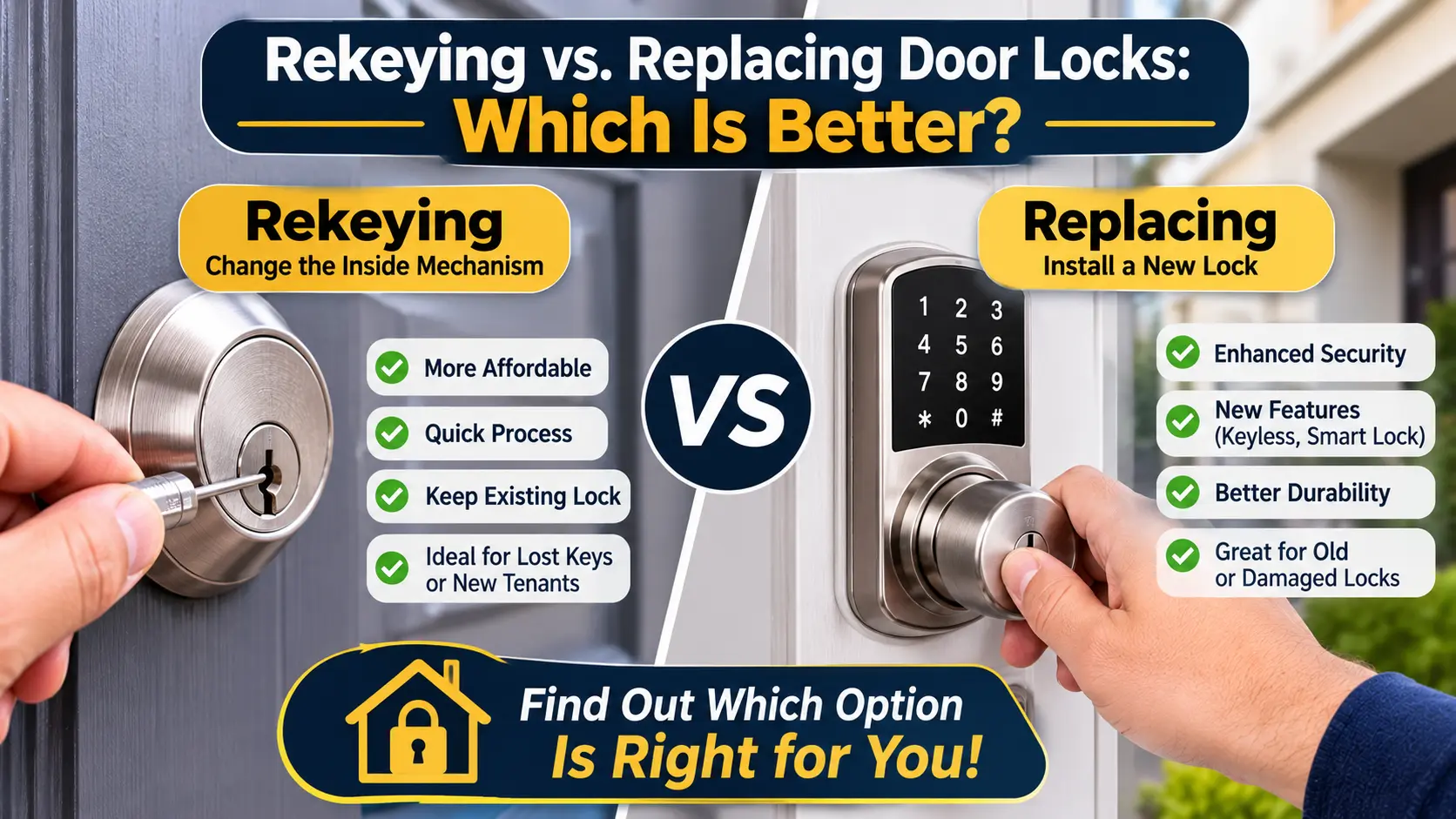
While both of them assist homeowners in regaining control over property accessibility, they address distinct security issues. While lock replacement eliminates the old hardware and installs a whole new locking structure, rekeying modifies the internal pins of an old lock so that its previous keys are no longer functional.
Which choice, then, is better for your house? The answer will depend on the state of your locks, your safety concerns, and whether you want to replace your hardware or only need new keys. To assist Michigan homeowners in making an informed choice, this guide evaluates the advantages, disadvantages, and best circumstances for each alternative.
Rekeying vs. Replacing Door Locks: What Are the Main Differences?
Rekeying and replacing locks differ in terms of cost, installation requirements, hardware modifications, and long-term functioning, even though both services help homeowners in controlling property access.
What homeowners should think about before selecting either service is highlighted in the comparison that follows.
| Comparison factor | Lock Rekeying | Lock Replacement |
| Main purpose | Changes which keys operate the existing lock | Replaces the existing locking hardware |
| Existing hardware | Usually retained | Removed and replaced |
| Old keys | Stop working after successful rekeying | Stop working with the removed lock |
| Cost | Generally more affordable | Generally more expensive |
| Installation time | Usually quicker | Depends on lock type and installation requirements |
| Security improvements | Restores control over existing key access | Can provide upgraded security hardware |
| Design options | Keeps the existing lock appearance | Offers new styles and finishes |
| Smart lock compatibility | Limited to compatible existing systems | Allows installation of suitable smart locks |
| Best suited for | Lost keys, new homeowners, access control | Damaged locks, outdated hardware, security upgrades |
Rekeying alters key compatibility but not the lock’s power or security rating. Although a new lock by itself can not ensure total door security, replacement allows householders to solve physical restrictions.
What Is Lock Rekeying?
A locksmith service known as “lock rekeying” modifies an existing lock’s internal setup to allow it to function with a different key. A locksmith takes out the lock cylinder, changes or substitutes its internal pins, and sets it up for use with a fresh key during this procedure. Owners do not need to buy a completely new locking system because the physical lock usually stays in place.
For instance, copies of the original keys can still be in the possession of previous proprietors, residents, contractors, or other people if you move into a formerly owned house. And you will be completely secure and in control.
Key Benefits:
- Better key control: After the lock has been correctly rekeyed, older keys cease to function.
- Reduced initial cost: Rather than buying new locks, you can keep compatible hardware.
- Easy access control: It is occasionally possible to set up several compatible locks to function with a single key.
- Minimal disturbance: Rekeying typically requires less time than taking out and putting in several new locks.
- Preserved hardware: You are able to maintain your current locksets, handles, and outer design.
Rekeying, however, does not automatically modernize an antiquated locking system, reinforce weak door frames, or fix faulty locks.
When Should Homeowners Rekey Their Door Locks?
Here are some common situations where professional lock rekeying makes sense.
- When you move into a new home
- When you lose your house keys
- When a tenant moves out
- When you share keys with contractors
- When you want one key for multiple doors
What Is Lock Replacement?
More than just an everyday discomfort, a lock that sticks, jams, or fails to shut your door can leave your house vulnerable at any time. Changing the key might not be the solution in such cases. To restore efficiency or increase home security, lock replacement entails taking out the current locking mechanism and installing a brand-new one.
Lock replacement offers homeowners a new beginning with new locking parts in contrast to rekeying, which only updates the internal pin layout while retaining the original hardware. When a lock is broken, worn out, out-of-date, or no longer satisfies your security requirements, it can be required.
Replacing an outdated lock might also present a chance for Michigan homeowners to update to smart locks with keyless access, high-security cylinders, or strengthened deadbolts. Your door type, security concerns, and desired degree of convenience will determine which replacement is best for you.
Key Benefits:
- Fresh hardware: Replaces worn-out, damaged, or broken parts.
- Compatibility: Modern deadbolts and other security-focused locking systems can be installed due to security enhancements.
- Design flexibility: Offers choices for various hardware configurations, styles, and finishes.
- Advanced functionality: Supports the installation of electronic access solutions, keyless entry systems, and smart locks.
- Greater dependability: Recurring issues brought on by failing internal parts can be fixed with an appropriate new lock.
The primary factor is that replacement demands new machinery and installation personnel; it typically costs more than rekeying.
When Should Homeowners Replace Their Door Locks?
Consider lock replacement in these situations.
- Damaged or worn-out locks
- Break-ins or attempted forced entry
- Upgrading to high-security locks
- Installing smart or keyless entry systems
- Outdated locking systems
Is Rekeying Cheaper Than Replacing Door Locks?
Yes. Because rekeying uses the current hardware and requires fewer materials, it is typically less expensive than replacing a door lock. The number of locks, lock type, cylinder design, servicing location, and labor requirements are some of the variables that affect the final cost.
| Cost factor | How it affects pricing |
| Number of locks | More locks generally increase the total service cost |
| Lock complexity | Specialized or high-security cylinders may require additional labor |
| Hardware condition | Damaged components may require repair or replacement |
| New hardware | Replacement includes the cost of purchasing new locks |
| Lock compatibility | Nonstandard doors or hardware may require additional adjustments |
| Emergency service | After-hours or urgent appointments may involve additional charges |
Which option offers better value?
Rekeying is typically the more cost-effective option if your current locks are operational and your primary concern is keeping outdated keys. Replacing your locks could be a better long-term investment if they are broken, out-of-date, or lack the functionality you require.
Before making a choice, homeowners should ask a qualified locksmith for an estimate. Avoiding needless expenses can be achieved by comparing the cost of rekeying with the cost of appropriate replacement hardware.
Rekeying vs. Replacing Door Locks: Which Is More Secure?
Neither option is automatically more secure than the other. Security depends on the condition. Neither choice is inherently more secure than the other. The state, design, installation, and quality of the locking system all affect security.
Rekeying renders previously issued keys useless, restoring key control. It does not, however, strengthen the lock’s defense against forced entry, picking, drilling, or physical assaults.
Installing hardware with more robust security measures is possible when a lock is replaced. A badly placed high-security lock, however, can nevertheless make the property vulnerable.
Homeowners should think about the following to improve residential security:
- On outside doors, install a lock with a suitable deadbolt.
- Use the right sized screws and strengthened strike plates.
- Make sure the deadbolt is completely inserted into the door frame.
- Assess the hinges, frame, and door.
- Select locks that have required security certifications.
- Updating access codes and maintaining electronic locks are important.
How Does a Professional Locksmith Decide Between Rekeying and Replacement?
Before offering a service, a professional locksmith typically takes into account the particular kind of hardware used, the homeowner’s safety concerns, and the state of the current lock.
A number of steps are usually involved in the process:
- Analyze the lock:
The locksmith looks for wear or damage on the cylinder, inner mechanism, deadbolt, and external hardware.
- Determine the security issue:
The homeowner clarifies whether the problem is related to misplaced keys, former tenants, illegal entry, or broken hardware.
- Verify the suitability of the lock:
The locksmith ascertains whether several locks can be operated with the same key and whether the current cylinder can be rekeyed.
- Compare the solutions:
Rekeying might be adequate if the hardware is working. Older or damaged locks might need to be replaced.
- Perform the service:
The locksmith verifies the locking mechanism and completes the authorized repair.
- Check the new lock or key:
The locksmith confirms that the door locks and opens smoothly and that the new key functions properly.
This assessment helps homeowners choose a suitable solution without paying for unnecessary hardware or overlooking existing security problems.
Conclusion
Your current hardware and security requirements will dictate whether you should replace or rekey your door locks. Rekeying is an economical choice if your locks are in good shape, but you want to stop outdated keys from functioning. Replacement can be preferred if your hardware is broken, out-of-date, or no longer satisfies your needs.
Secure Your Michigan Home With Professional Locksmith Services
Classy Locksmith offers trustworthy residential locksmith services in Michigan with over 20 years of expertise, a staff of 50+ specialists, and a track record of 100+ completed projects. Our team of experts is prepared to assist you whether you require lock rekeying, damaged lock repair, or a full home security improvement. We provide mobile locksmith services that are available 24/7. With us, you can even get emergency locksmith help, delivering expert assistance to your area whenever you need it.
To explore your domestic lock security requirements and receive experienced locksmith support for your Michigan home, get in touch with Classy Locksmith right now.